
Wilkes University Archives is excited to announce that Victoria Rendina, a Creative Writing M.A. graduate (2024) and current student for the Creative Writing MFA, has processed the J.Michael Lennon collection of Norman Mailer research, 1948-2024. In addition to earning an MA in Creative Writing, Victoria was the recipient of the January 2024 Norris Church Mailer Scholarship. Victoria is currently slated for publication in Fantasy & Science Fiction Magazine and published a poetry collection, Shadow Truths in 2020, among other local poetry and fiction publications over the years. Outside of school and writing, Victoria has established a community-driven digital literary magazine for NEPA creatives, The Valley with a Heart.
To view the finding aid, visit here. The finding aid and blog post were supervised and edited by Suzanna Calev, Wilkes University Archivist. Below are Victoria’s reflections on the collection.
J. Michael Lennon’s collection of Norman Mailer’s Publication Research, 1948-2024, spans the vast arc of writer Norman Mailer’s literary career, personal life, and posthumous legacy. The materials within this collection include manuscript drafts, publications, periodicals, artwork, certificates, and research written and compiled by Norman Mailer, as well as publications and periodicals written about Norman Mailer. The collection also includes manuscript drafts, publications, and periodicals of works from Mailer’s colleagues and family, correspondences, ephemera from Mailer’s Provincetown study, and photographs.
The collection is divided into eight series: Series I: Publications, 1948-2024; Series II: Speeches and Interviews, 1962-2006; Series III: Unpublished Works, c. 1945-2004; Series IV: Personal/Family, 1978-2007; Series V: Correspondences, 1947-2007; Series VI: Norman Mailer’s Legacy, 1970-2023; Series VII: Personal, c. 1948-2011; and Series VIII: Objects, c. 1990s – c. 2005. Each series is further divided into subseries and subsubseries to aid researchers in consulting these subjects. The collection was donated to Wilkes University by Dr. J. Michael Lennon, Wilkes’ Emeritus Professor of English and Norman Mailer’s archivist and authorized biographer, and additional Mailer manuscripts were donated by American photojournalist and film producer, director, and screenwriter, Lawrence Schiller, in December 2023. Wilkes professor Emeritus Bonnie Culver was instrumental in making the arrangements to transport Mailer’s study contents from Schiller’s Norman Mailer Center storage units in New York City to Wilkes University during the Summer 2017.

Found in Series VII, Subseries III, Subsubseries I, Folder 82.11.
Norman Mailer was born January 31, 1923 to Jewish immigrants Isaac Barnett “Barney” Mailer and Fanny “Fan” Mailer (née Schneider). With his mother’s encouragement, Mailer began writing stories as early as seven or eight. Mailer made note of this on his application to Harvard University and began his studies at the school in 1939. He majored in engineering sciences, but followed his passion for writing with electives, was a member of Harvard’s Signet Society, and worked on the Harvard Advocate. After graduating from Harvard in 1943, Mailer married his college girlfriend and first wife Beatrice “Bea” Silverman in 1944.
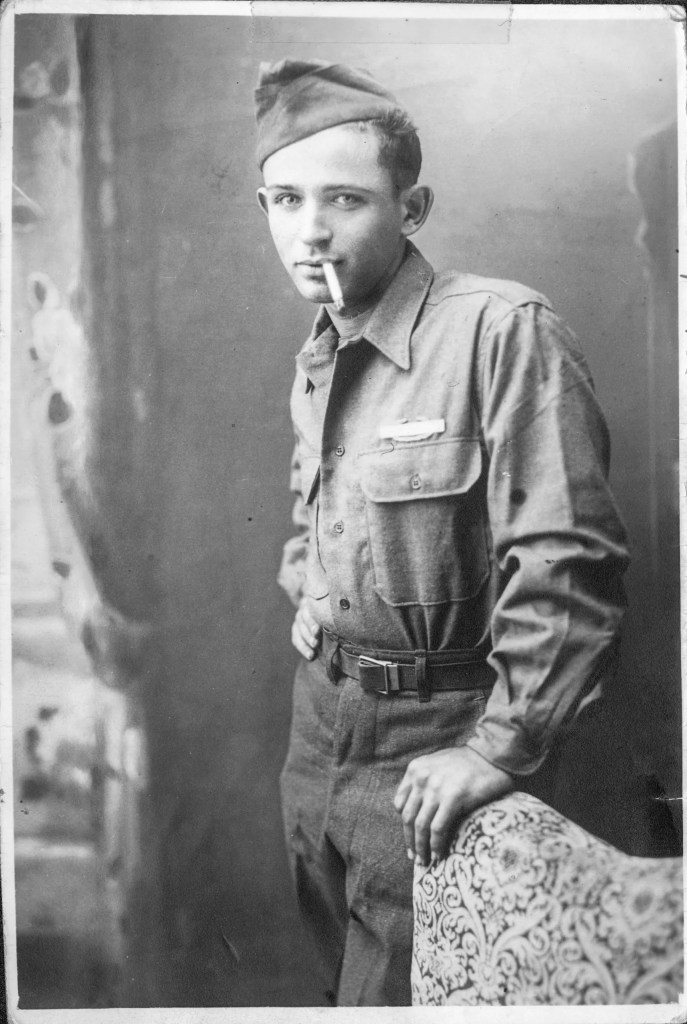
April, 1946
The New Yorker from the Norman Mailer Estate Archives
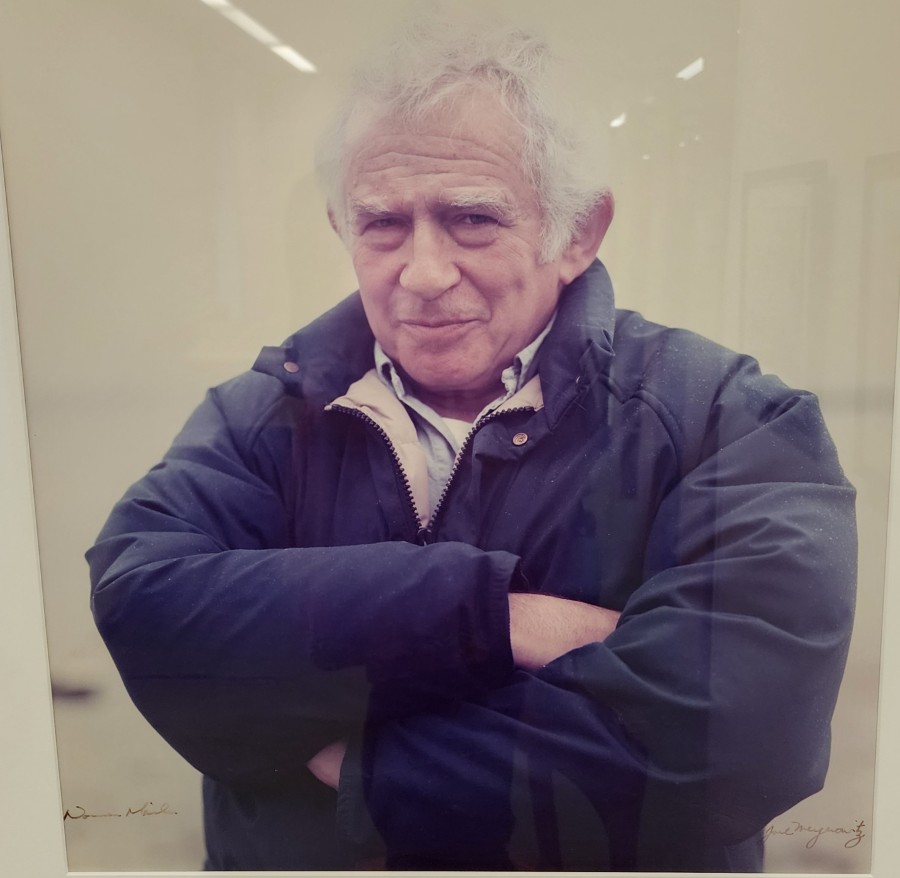
Portrait is also located outside recreation of Mailer’s study, E. S. Farley Library at Wilkes University
That same year, Mailer was drafted into the U.S. Army. He wrote to Bea almost daily while serving in the army, his letters and experience building the basis for his acclaimed war novel The Naked and The Dead. Published in 1948, The Naked and the Dead sold 200,000 copies in its first three months, and remained on the New York Times best seller list for 62 weeks.
Outside of this collection, the Wilkes University Archives holds over 21 rare editions of The Naked and the Dead preserved in our Norman Mailer Study, including an advance review copy from 1948 signed and dated by Larry McMurty, who sent it to Mailer on his 50th birthday on January 31, 1973. Mailer inscribed it as follows: “From Larry to me (on my fiftieth birthday) and from me to you, Mike Lennon. Cheers→ Norman July 2005


“From Larry to me (on my fiftieth birthday) and from me to you, Mike Lennon. Cheers→ Norman July 2005″


The Naked and the Dead sparked the beginnings of Mailer’s successful literary career. The materials in this collection not only highlight the success of that novel in reviews, but also showcase the extensive work Mailer put into sustaining his career. In addition, the collection broadens insight on Mailer’s personal life beyond catchy headlines with materials relating to collaborative writing efforts with family and colleagues, family photos, and a vast collection of gifts, trinkets, artwork, and other ephemera that once filled Mailer’s Provincetown study. This study was replicated by Wilkes University Archivist Suzanna Calev in Fall 2019 on Farley Library’s second floor. A photograph is featured below.

This replicated study is filled with Mailer’s research library as well as photographs, personal memorabilia and his original furniture. Although not an identical replica, the study does provide an idea of what Mailer’s writing space was like and what books he referenced on a daily basis. In line with this display of personal and professional artifacts found in Mailer’s Provincetown study replication, the focus of this blog post is to showcase this dichotomy between personal and professional in Mailer’s career.
Mailer’s Editing Process
Within the collection’s first series (Series I: Publications, 1948-2024) and subseries (Subseries I: Book Publications, 1948-2007), the materials pertain to Mailer’s drafting efforts with draft manuscripts and for books such as The Castle in the Forest (2007), The Deer Park (novel, 1955), The Executioner’s Song (1979), The Gospel According to the Son (1997), Harlot’s Ghost (1990), and Modest Gifts (2003)with galley copy of Portrait of Picasso as a Young Man (1995) and a script narration draft for Mailer’s film adaptation of Tough Guys Don’t Dance (1987).
In this collection, reviews and interviews for these publications, along with other works in Mailer’s bibliography, come from periodicals such as The New Yorker, Newsweek, Saturday Review of Literature, Provincetown Arts, Parade Magazine, The Guardian, Esquire, Associated Press, The New York Review of Books, The New York Post, The Washington Post, and The New York Times Book Review.
Spanning from June 1999 to May 2006, and a total of 20 standard size boxes in the entire collection, the layers of Mailer’s drafting process are most evident with his last novel, The Castle in the Forest. What I’ve come to learn about writing is that, besides honing our skill and craft over years, our best work takes time, patience, and revision after revision. Assembling these boxes in the collection only proved this idea to me. What we start writing might not even make it in the final cut of our work, or, as in the case of Mailer’s first handwritten pages of Castle, might find new life in an entirely different form within the work.


Drafted June 4, 1999
Found in Series I, Subseries I, Subsubseries IV, Folder 1.15.
Mailer hand wrote the two pages pictured above in June, 1999. Twelve pages in total, this early draft of Castle is far from the opening of the published version. The transcription of these first two pages are as follows:
“I am who I am, but that does not mean I feel myself [unsure; crossed out] above all forms of human [activity; crossed out] effort. For an instance, I am intrigued with the notion of writing a novel. That is [unsure; crossed out] a sport! Even the gods know how to amuse themselves with novels. Indeed, they have been known to descend into the minds of authors when looking for a vehicle by which to express themselves.
In that vein, I am intrigued withI would not be part of such a culture, however. The writer one chooses can be undefendable. Rather, I am more intrigued with the notion of writing a novel (an historical novel!) that would be altogether unlike others, a species of good short work, a sustained piece of story telling offered by one man to another over the course of a
night in a small room at the periphery of the uproar that is going on in a Konzentrationslager that has just been captured by American soldiers very late in April, 1945.
As the two men converse, a pistol lies on the table. It is close to the younger man who is American, and [inserted: is] a doctor, a Captain[
, and a J in]in rank. He is Jewish, a part of the U.S. Army force who have just reached the concentration camp a few hours ago and have of course, been appalled by what they saw. Indeed, a few German officers were shot on the spot.The Jewish doctor, [inserted: despite his uniform, is] very much a pacifist [inserted: by temperament] was withdrawn from the uproar and the hideousness of the odor, the collective emaciation, and the various other appalling sights[
.][inserted: andsniffs.pesticidal[sniffs]sniffs.]He has orderIndeed, he has ordered his opposite number , a German doctor, considerably older than hismself (fifty let us say as opposed to thirty-odd years) into a small sentry roomwith a table and annear [inserted: one of the last] barbed-wire enclosures of the camp,. and there, through…”
Castle underwent pages upon pages of revision, as evident by its size in this collection. Mailer established a multitude of draft versions as well, such as “faxed copy” “double spaced” versus “triple spaced,” “New Drafts C, D, and E” such as those pages in folder 5.3., “New Draft CB” such as those pages in folder 5.4., and other takes and “outtakes” throughout the drafting process. In addition, the drafting had been broken up by chapters as well as books, where many of the “books” became the structure finalized in Castle’s publication. As for those first two pages previously transcribed, threads of that work wound up in the novel’s epilogue:


Found in Series I, Subseries I, Subsubseries IV, Folder 19.16.
Though some written lines in the original first draft were omitted from the epilogue draft, the comparison between the two shows the way writers give new life to their material when revision changes the direction of their work.
Mailer’s revision process wasn’t always done independently. Within the collection, there are a variety of “spot notes” and other forms of feedback on Mailer’s work from his close colleagues, family, and friends. J. Michael Lennon and Tatiana Kudriavtseva offered spot notes on specific pages and chapters, in addition to Mailer’s own notes, for The Castle in the Forest (see Box 34, Folders 19-22; Subsubseries XXXI). Daughter Maggie Mailer provided notes on Oswald’s Tale (Folder 54.2.). My personal favorite within this collection is Norris Church Mailer’s commentary on The Gospel According to the Son.
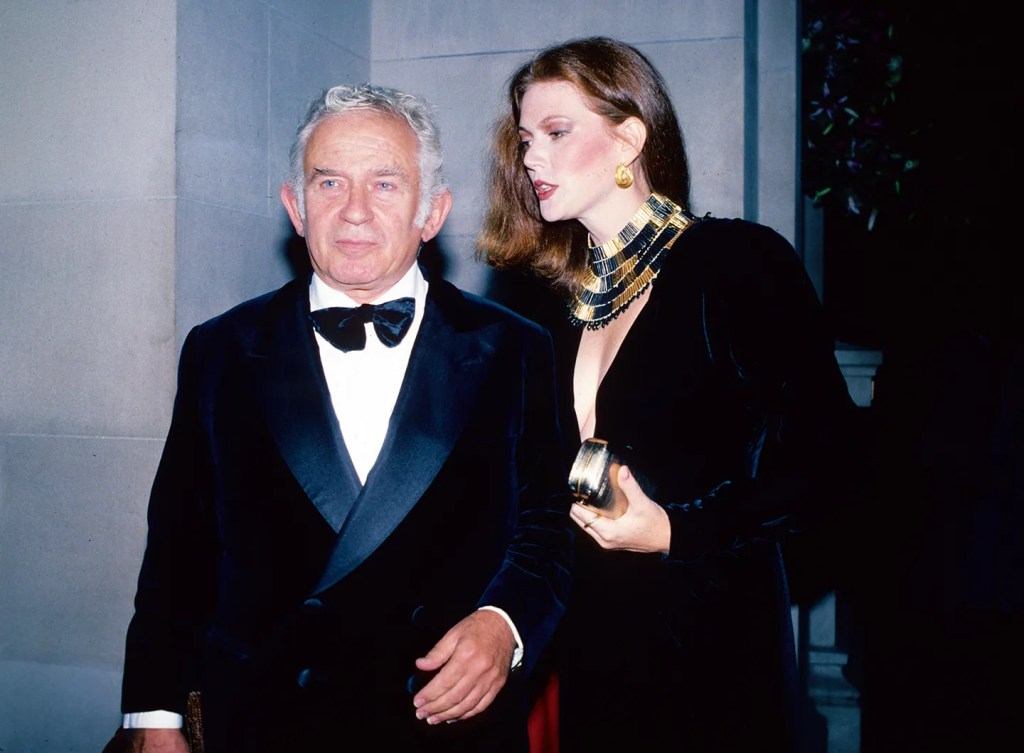
February 7, 1981
Vanity Fair from Associated Press File Photos

Found in Series VII, Subseries IV, Folder 83.7.
Norris Church Mailer (born Barbara Jean Davis) was Norman Mailer’s sixth and final wife. Norris was a novelist, actress, artist, and model, whose life with Norman she aptly described with the title of her memoir: A Ticket to the Circus. As the ringleader in unifying the Mailer children into a family, as well as juggling her own creative endeavors, Norris had described her relationship as keeping her husband on track with his own work. Her revision notes for The Gospel According to the Son prove her commitment to this undertaking.


Found in Series I, Subseries I, Subsubseries XLIX, Folder 46.8.

Black ink is Norris Church Mailer; blue/pencil is Norman Mailer
NCM: 205. Really, must we have a bucking colt? Can’t He have a little dignity? He was the colt for me???
NM: too modern
NCM: 207. Wasn’t there a lovely “O Jerusalem” speech here? “How often I would have gathered you to me … but you would not” or something
NM: Luke has a good passage and it does need more here
When I first reached out to J. Michael Lennon to confirm the handwriting on these pages, he elaborated that “Norris was a Baptist from Arkansas, and knew the New Testament. Norman was a Jew and knew the [Old Testament].” From my perspective, this collaboration between Norman and Norris is just a fraction of the full “village” it takes for a writer to put their best work forward.
In addition to a vast drafting and revision process, Mailer’s research process spans a bulk of this collection. For The Castle in the Forest, the research consists of 20 boxes alone (Boxes 22-42), with each theme of Mailer’s Castle-specific research further categorized into subseries. Given Mailer’s bibliography, his extensive research was necessary for the accuracy of portraying key figures in history, be it in his fictional works such as Castle or The Gospel According to the Son, or in his nonfiction works such as Oswald’s Tale.

Found in Series VII, Subseries III, Subsubseries I, Folder 82.9.
Given its size in the collection, the compiled research for The Castle in the Forest best exemplifies Mailer’s research process. Within the collection are original book and periodical publications, along with copies and excerpts of these publications, full of handwritten notes and highlights on specific details involving Hitler’s adolescence and family, historical timeline context, reflections and analysis of Hitler post-WWII, and other elements for expanding and authenticating the details of this novel.
Publications within the series include: Mein Kampf by Adolf Hitler, Hitler 1889-1936: Hubris by Ian Kershaw, The Psychopathic God: Adolf Hitler by Robert G. L. Waite, and Foundations of the 19th Century by Houston Stewart Chamberlain (translated by John Lees). The collection also includes specific handmade pages of indexes (both handwritten and typed) Mailer utilized to keep track of books read, partially read, or didn’t read.

Found in Series I, Subseries I, Subsubseries XXXII, Folder 34.25

compiled c. 2000s
Found in Series I, Subseries I, Subsubseries XXXII, Folder 34.24
As mentioned, the authenticity of a novel’s details, or its verisimilitude, is necessary for any writer within their research process, whether or not their work utilizes historical context to the same extent as Mailer’s. When it comes to Mailer’s career, the research within this collection highlights the journalistic side of his bibliography. When put in the context of a fictional novel, such as Castle, the research then exemplifies the way in which all the outlets of Mailer’s career worked together, while showcasing his dedication to his craft.
A COLLABORATIVE EFFORT
Though this collection offers insight on Mailer’s personal career as a writer, it also features collaborative efforts regarding publications with others as well as the creative work of close colleagues and family members in Subseries IV: Published Works with Others, 2002-2007. Collaborative works within this subseries include The Big Empty: Dialogues on Politics, Sex, God, Boxing, Morality, Myth, Poker and Bad Conscience in America by John Buffalo Mailer and Norman Mailer (2006) and On God: An Uncommon Conversation by Norman Mailer and J. Michael Lennon (2007).

The Norman Mailer Society for Normanmailer.us on Medium
Photo taken by Norris Church Mailer

Drafted August, 2005
Found in Series IV, Subseries I, Folder 66.9.
When asked “Why did you write the book?” by Dotson Rader in an interview for C-SPAN and the New York Society for Ethical Culture in 2006, John Buffalo Mailer stated “[The Big Empty] … was about making Norman Mailer accessible to the younger generations” since most questions regarding a post-9/11 world prompted Buffalo Mailer to think “‘If you could talk to Norman Mailer, you could get more insight into that.” Prior to their arrangement in The Big Empty, several of the interviews between father and son had been published in publications such as Playboy (“Reflections on Courage, Morality, and Sexual Pleasure,” December 2004) and Stop Smiling Magazine (“Mailer vs. Mailer,” 2005), among others. The topics of these interviews include, but are not limited to: existentialism, post-9/11 America, the Bush Administration, writing, family, sex, and morality. In that same C-SPAN interview with Dotson Rader, Mailer claims that “as a novelist, I consider it incumbent upon myself to try and understand how people I am not particularly fond of do their thinking.”
With interviews spanning the course of a year starting in 2004, The Big Empty illuminates the ways in which Norman’s worldview influenced his means of creative thought, as well putting forth the spotlight on his son for his own career as a writer and interviewer. As evident from both father and son agreeing to disagree on certain subjects (like pessimism vs optimism with global affairs) within their interviews, The Big Empty exists as a means of highlight the ways writers and thinkers of past generations, or Norman Mailer’s “hyperbolic” Great Generation, can help reshape the ways in which younger generations, like John Buffalo Mailer’s, can navigate the present for the sake of the future. Including the collaborative effort between father and son in this collection exemplifies the melding of generations they both strived to bring together in creating this book.

J. Michael Lennon for Normanmailer.us on Medium

c. 2005
Found in Series I, Subseries IV, Subsubseries II, Folder 62.1
In On God’s collaborative conversation between Mailer and Lennon, interviews were conducted as early as December 30, 2002 (“God Interview, 1”) up until October 19, 2006 (“Theology Interview IX”) and were revised from December 12, 2003 until May 22, 2007. These interviews, often noted in the collection as “Theology Interview I-IX,” span a variety of topics, including grace, “prayer and ritual,” evolution, “evil and the nature of the devil,” and fundamentalism, as Mailer mentions in the note pictured above. The inclusion of these drafts and notes in this collection highlights the bond built between Mailer and “friend and literary executor” Lennon in ways that exemplify Lennon’s biographical work on Mailer showcased in Series IV: Norman Mailer’s Legacy, 1970-2023.

November 19, 1992
Found in Series VI, Subseries IV, Subsubseries I, Folder 77.12
J. Michael Lennon began his scholarly work on Norman Mailer at the University of Rhode Island, where he wrote his Ph.D. dissertation on Mailer’s The Armies of the Night under Dr. Nancy Potter’s direction. Lennon and Mailer met in 1972 following a letter Lennon wrote to Mailer in his support after an altercation on The Dick Cavett Show. As Lennon wrote in his essay collection, Mailer’s Last Days (2022), for thirty-five years, he and Mailer “grew closer in aesthetic interests and fervor for the same philosophical entanglements.” The relationship between Lennon and Mailer has preserved Mailer’s legacy through Lennon’s archiving and biographical efforts.

Preface drafted: March 1999
Found in Series VI, Subseries II, Subsubseries III, Folder 75.15
In transcribing these two pages, Mailer describe Lennon’s archiving efforts best:
PG 2: Without the participation of my good friend Mike [
Lennon and] as a pro bono archivist, my literary estate would have [inserted: long ago] become achaos ofdumping ground of moldering unlabelledcartons.cardboard boxes. By his efforts, however, which go back [inserted: over] more than two decades, my literary artifacts have [inserted: since] become well-organized, indeed, so well-organized by his passion for precision and documentation that the result could appear obscene to me in its perfection, if it were not for the fact that I need it [inserted: and use it] like a boneneedswith its marrow. Should the gods who look after posthumous literaryhegemonylife choose to decide in my favor—an assumption that no writer can make with confidenceabout his long term futurewhat with literary history flinging many a good [inserted: dead] writer off the roadon its abrupt turns—yes—than, for certain, if a reasonablegood enddenouement does come to my work,thenthe materials to support this scribblerare[inserted: have been put] in place.Whereas, if IAnd should I end my occupying no [inserted: larger] placebutthan a footnote in literary history, it will not be [inserted: the fault of]PG 3:
Michael Lennon’s fault. On the other hand if the[inserted:those] historic tides that carry a few authors’ boats to [inserted: the] golden islandswhere aof posthumousreadership dwells also include me, why, then, Mike’s hand kept its watchinvestiture will [crossed out; illegible] have felt Mike’s hand on the tiller. So let these words serve to express the size of my debt.to him.Three cheers for my friend, Mike Lennon,No better—a standingand my own private ovation for Works and Days.
Lennon’s close connection to Mailer and care of his literary estate is evident in the scope of this collection’s contents. To include materials from J. Michael Lennon’s career alongside Mailer’s highlights the dynamic between writers and the ways in which that dynamic strengthens each other’s career. What one writer might refer to as networking, the other might consider this relationship between writers as an essential part of the writing process. In Lennon’s case, this connection to Mailer was crucial for his career as a writer, while simultaneously benefiting the posthumous legacy for Mailer.
In addition to Mailer’s connection with J. Michael Lennon, the collection equally highlights Mailer’s professional relationship with close friends, family, and peers.
Within Series IV: Personal/Family, 1978-2007, the collection highlights works created by or about Mailer family such as Adele Morales (addressed as Adele Mailer in collection materials), Danielle Mailer, John Buffalo Mailer, Maggie Mailer, Matthew Mailer, Norris Church Mailer, and Susan Mailer. The collection also includes draft copy and galley copy materials from peers such as Peter Alson, Peter Levenda, Lawrence Schiller, Richard Stratton, and Kim Wozencraft. Many of the works within this series feature commentary, correspondence, or revision notes from Mailer. Schiller’s Perfect Murder, Perfect Town script best exemplifies this process between writers.


First picture depicts “first pass” of drafting, with Mailer’s revisions in pencil (Folder 72.8)
Second picture depicts “second pass” of drafting implementing Mailer’s edits (Folder 72.10)
November 26, 1999
Found in Series IV, Subseries II, Folders 72.8 and 72.10
Mailer’s relationship with Lawrence Schiller, who was one of his most important collaborators, began with his biography on Marilyn Monroe, titled, Marilyn: A Biography, published in 1973. In 1974, they worked together on The Faith of Graffiti, published within the same year. A few years later, they came together again in 1977 with Schiller’s adaptations of Mailer’s The Executioner’s Song and Oswald’s Tale. Perfect Murder, Perfect Town (2000) was Schiller’s television miniseries following the botched investigation into the murder of six-year-old JonBenét Ramsey.
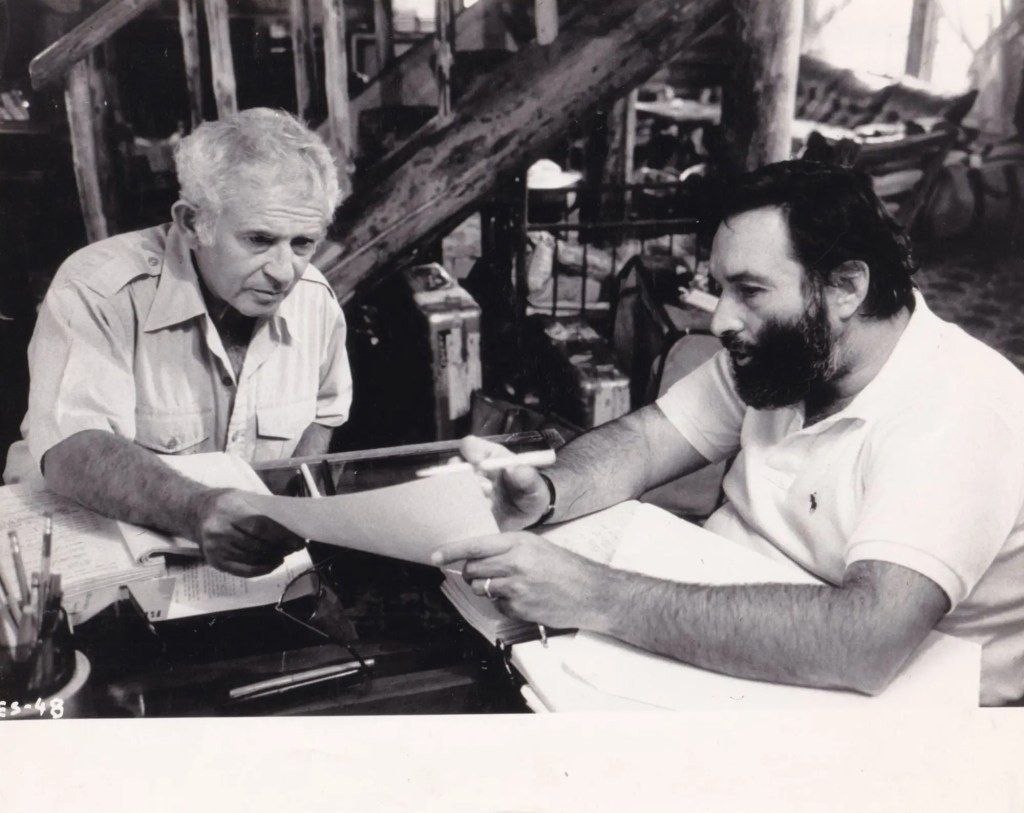
Royal Books and Lawrence Schiller Productions, 1982
In building their creative connection off of previous work together, Mailer offered revisional feedback for the “Pink Shooting” draft script in 1999, which Schiller then implemented into the draft. One could argue that when a successful writer such as Mailer offers edits to your working draft, you listen. However, I choose to believe that great writers bounce ideas off each other for the betterment of their peers, implementing any revisions they deem necessary to put out their best work. In connecting with other writers, we often fuel our own creativity, as well as build a trusted community. And Mailer’s connection to fellow writers exemplifies the necessity of building creative connections.
At Wilkes You Will… Learn All About Norman Mailer
As a lifelong colonel with Wilkes University, the inclusion of a writer’s legacy here on campus is not something I take lightly. I’m currently an MFA student in the Maslow Family Graduate Program in Creative Writing, but I also earned my BA in English from Wilkes in 2015. I’m a horror and fantasy fan at heart, but I will always hold my love of the classic novels and writers close to me. I knew of Norman Mailer from my years of undergraduate English courses, but getting to know the literary giant’s dedication to his craft and career by working with this collection is an enriching experience unlike a name drop in the Norton Anthology. Each piece of Mailer’s importance to Wilkes makes me appreciate the collection on a deeper level.

November 19, 1992
Found in Series VI, Subseries IV, Subsubseries I, Folder 77.12


November 19, 1992
Found in Series VI, Subseries IV, Subsubseries I, Folder 77.9
While serving as the Vice President of Academic Affairs in 1992, J. Michael Lennon, along with then Wilkes President Christopher N. Breiseth and the English Department Chair Patricia Heaman, invited Norman Mailer to speak on campus (“An Evening with Norman Mailer,” November 19, 1992) while the E.S. Farley library displayed his papers and first editions of his books that same month (“Norman Mailer: An Exhibition of The Man and His Works”). The connection between Mailer and Wilkes stemmed from that event, leading to Mailer’s Doctoral Honor’s and Spring Commencement Speech in 1995, as well as an invitation to speak in the Max Rosenn Lecture series at Wilkes (“Norman Mailer on American Presidents: JFK to WJC,” April 1, 2001) and the dedication of the “Norman Mailer Room on April 1, 2001).

May 27, 1995
Found in Series VI, Subseries IV, Subsubseries II, Folder 77.21
Mailer continued his commitment to Wilkes University with a keynote address at the inaugural Pennsylvania Writers Conference in June 2004, marking the beginnings of his advisory board involvement with Wilkes’ Creative Writing Master’s Program launched by J. Michael Lennon and Bonnie Culver that same year. The Norris Church Fellowship within the Creative Writing Master’s Program was established in 2004 in Norris’s name and has been awarded annually to a student in the program since 2005.

Left to right: Victoria Rendina, John Buffalo Mailer, and Tasha Saint-Louis
January 12, 2024
Photo courtesy of Keith Perks (112o Creative)
As the January 2024 recipient of the Norris Church Mailer Scholarship, the connection the Mailers have had with Wilkes has always been for the betterment of the school, along with its students. To know a writer’s legacy remains here in my own backyard, and my own “stomping ground” given all my time here at Wilkes, is important for literary stewardship and preserving one of the many writers that shaped modern forms of storytelling. For example, Mailer is regarded as one of the forerunners to New Journalism, an unconventional means of reporting in the 1960s and 1970s where reporters interpolate subjective language within facts while immersing themselves in the stories. Mailer exemplifies this form of journalism in his work Miami and the Siege of Chicago (1968), but the materials within this collection exemplify his commitment to immersing himself within his bibliography in whole.


Found in Series VII, Subseries III, Subsubseries I, Folder 82.8.
Though Mailer’s legacy extends beyond his close connection to Wilkes University, I have noticed the ways in which this connection to Wilkes has only amplified the preservation of Mailer’s career. The Norman Mailer Society was established in 2003 to celebrate Norman Mailer. It has approximately 300 members and meets annually for three days for panels, papers, films and informal discussion about the life, work and reputation of the late Norman Mailer.
The Society has also worked in collaboration with the Maslow Family Graduate Program in Creative Writing at Wilkes University. Though defunct now, the Norman Mailer Writers Colony was a nonprofit that started in 2008. The summer colony was first held at the former Mailer home in Provincetown, Massachusetts. Several Wilkes faculty and board members were among those who taught in the summer colonies, including, J. Michael Lennon, Kaylie Jones, Bonnie Culver, Beverly Donofrio, and Colum McCann. The folding of the Writer’s Colony has led to the donation of Norman Mailer’s library and study to Wilkes University’s E.S. Farley Library, as well as the material archived in this collection as a whole along with J. Michael Lennon’s donations.

November 1, 2003
Found in Series VI, Subseries I, Subsubseries I, Folder 74.19.
To preserve one writer’s legacy in a collection like this one means that a generation of writing knowledge, insight, and craftsmanship will be accessible for generations to come. J. Michael Lennon’s collection offers a literary “timestamp” of cultural influences that span the length of Mailer’s career. In addition to Mailer’s bibliography, this collection highlights the ways in which writers expand their career beyond fiction and non-fiction books, and how other creative outlets such as film or art only fuels the writer’s craft at large.

Found in Series I, Subseries , Subsubseries LV, Box 48
Often influenced by the politics and culture of his lifetime, Mailer’s work indicates a writer’s need to challenge the established status quo with a critical lens for the sake of moving the national and global narrative forward. Perhaps some facets of Mailer’s career resulted in expressed opinions or beliefs we’d refer to as a “product of his time” now. However, from the Pulitzer Prize for both The Armies of the Night (awarded 1969) and The Executioner’s Song (awarded 1980), to Honorary Doctor of Letters from Rutgers University, Mercy College, and Wilkes University, Mailer’s dedication to his craft suggests a career as acclaimed as it was plentiful in works spanning across multiple creative outlets. As writer Toni Morrison said in her introduction of Norman Mailer for the 2005 Medal for Distinguished Contribution in American Letters at the National Book Awards ceremony, Mailer was “generous, intractable, often wrong, always engaged, mindful of and amused by his own power and his prodigious gifts, wide spirited. Like the nation itself, sui generis, a true original” (Morrison, “Introduction of Norman Mailer”).
The ultimate goal in establishing this collection is not only to exemplify Mailer’s commitment to his own craft. Rather, this collection offers a perspective on how one writer’s legacy has influenced writers during Mailer’s lifetime and beyond. As a conversation with J. Michael Lennon has indicated, Mailer was the type of writer that wanted to know everything about you and your work. In that regard, it makes sense that this collection highlights his own work, as well as his collaborations with others.
In addition, the items of personal value within this collection puts the person into question, rather than the “writer” or the “name you see in an anthology collection of literary legends.” And as Toni Morrison continued in her introduction of Mailer for the National Book Awards, “I think you would agree that for a writer this prolific, this able with language, he should have the last word” (Morrison, “Introduction of Norman Mailer”). In line with Morrison’s comment, I think it best to end on words Mailer wrote to inspire the young writers of Berrien Springs High School (Berrien Springs, MI) for their literary magazine The Pierian Spring in 1997. In doing so, I know Mailer’s words can encourage a sense of purpose in utilizing this collection as a whole.

Found in Series I, Subseries III, Subsubseries I, Folder 57.23
 Archives & Special Collections
One thought on “Norman Mailer: A Legacy Written through Revision and Collaboration”